Wednesday, 2 August 2017

Dwarf Planets: history,Exploration,mass moons,Name of dwarf Planets


Dwarf Planets 

(Dwarf Planets: history,Exploration,mass moons,Name of dwarf Planets)

Related image
A dwarf planet is a planetary-mass object that is neither a planet nor a natural satellite. That is, it is in direct orbit of a star, and is massive enough for its gravity to crush it into a hydrostatically equilibrious shape (usually a spheroid), but has not cleared the neighborhood of other material around its orbit.
The term dwarf planet was adopted in 2006 as part of a three-way categorization of bodies orbiting the Sun, brought about by an increase in discoveries of objects farther away from the Sun than Neptune that rivaled Pluto in size, and finally precipitated by the discovery of an even more massive object, Eris. The exclusion of dwarf planets from the roster of planets by the IAU has been both praised and criticized; it was said to be the "right decision" by astronomer Mike Brown, who discovered Eris and other new dwarf planets, but has been rejected by Alan Stern, who had coined the term dwarf planet in April 1991.
The International Astronomical Union (IAU) currently recognizes five dwarf planets: Ceres; Pluto; Haumea; Makemake; and Eris. Brown criticizes this official recognition: "A reasonable person might think that this means that there are five known objects in the solar system which fit the IAU definition of dwarf planet, but this reasonable person would be nowhere close to correct."
Another hundred or so known objects in the Solar System are suspected to be dwarf planets. Estimates are that up to 200 dwarf planets will be identified when the entire region known as the Kuiper belt is explored, and that the number may exceed 10,000 when objects scattered outside the Kuiper belt are considered.[dead link] Individual astronomers recognize several of these, and in August 2011 Mike Brown published a list of 390 candidate objects, ranging from "nearly certain" to "possible" dwarf planets. Brown currently identifies ten known trans-Neptunian objects—the four accepted by the IAU plus 2007 OR10, Quaoar, Sedna, Orcus, (307261) 2002 MS4 and Salacia—as "virtually certain", with another twenty highly likely. Stern states that there are more than a dozen known dwarf planets.
Only two of these bodies, Ceres and Pluto, have been observed in enough detail to demonstrate that they actually fit the IAU's definition. The IAU accepted Eris as a dwarf planet because it is more massive than Pluto. They subsequently decided that unnamed trans-Neptunian objects with an absolute magnitude brighter than +1 (and hence a diameter of ≥838 km assuming a geometric albedo of ≤1) are to be named under the assumption that they are dwarf planets.
The classification of bodies in other planetary systems with the characteristics of dwarf planets has not been addressed.

History of the concept


Starting in 1801, astronomers discovered Ceres and other bodies between Mars and Jupiter which were for decades considered to be planets. Between then and around 1851, when the number of planets had reached 23, astronomers started using the word asteroid for the smaller bodies and then stopped naming or classifying them as planets.
Related image
With the discovery of Pluto in 1930, most astronomers considered the Solar System to have nine planets, along with thousands of significantly smaller bodies (asteroids and comets). For almost 50 years Pluto was thought to be larger than Mercury, but with the discovery in 1978 of Pluto's moon Charon, it became possible to measure Pluto's mass accurately and to determine that it was much smaller than initial estimates. It was roughly one-twentieth the mass of Mercury, which made Pluto by far the smallest planet. Although it was still more than ten times as massive as the largest object in the asteroid belt, Ceres, it had one-fifth the mass of Earth's Moon. Furthermore, having some unusual characteristics, such as large orbital eccentricity and a high orbital inclination, it became evident that it was a different kind of body from any of the other planets.
In the 1990s, astronomers began to find objects in the same region of space as Pluto (now known as the Kuiper belt), and some even farther away. Many of these shared several of Pluto's key orbital characteristics, and Pluto started being seen as the largest member of a new class of objects, plutinos. This led some astronomers to stop referring to Pluto as a planet. Several terms, including subplanet and planetoid, started to be used for the bodies now known as dwarf planets. By 2005, three trans-Neptunian objects comparable in size to Pluto (Quaoar, Sedna, and Eris) had been reported. It became clear that either they would also have to be classified as planets, or Pluto would have to be reclassified. Astronomers were also confident that more objects as large as Pluto would be discovered, and the number of planets would start growing quickly if Pluto were to remain a planet.
Eris (then known as 2003 UB313) was discovered in January 2005; it was thought to be slightly larger than Pluto, and some reports informally referred to it as the tenth planet. As a consequence, the issue became a matter of intense debate during the IAU General Assembly in August 2006. The IAU's initial draft proposal included Charon, Eris, and Ceres in the list of planets. After many astronomers objected to this proposal, an alternative was drawn up by Uruguayan astronomer Julio Ángel Fernández: he proposed an intermediate category for objects large enough to be round but which had not cleared their orbits of planetesimals. Dropping Charon from the list, the new proposal also removed Pluto, Ceres, and Eris, because they have not cleared their orbits.
The IAU's final Resolution 5A preserved this three-category system for the celestial bodies orbiting the Sun. It reads:
The IAU ... resolves that planets and other bodies, except satellites, in our Solar System be defined into three distinct categories in the following way:
(1) A planet1 is a celestial body that (a) is in orbit around the Sun, (b) has sufficient mass for its self-gravity to overcome rigid body forces so that it assumes a hydrostatic equilibrium (nearly round) shape, and (c) has cleared the neighbourhood around its orbit.
(2) A "dwarf planet" is a celestial body that (a) is in orbit around the Sun, (b) has sufficient mass for its self-gravity to overcome rigid body forces so that it assumes a hydrostatic equilibrium (nearly round) shape,2 (c) has not cleared the neighbourhood around its orbit, and (d) is not a satellite.
(3) All other objects,3 except satellites, orbiting the Sun shall be referred to collectively as "Small Solar System Bodies."

Recognized

The IAU has recognized five bodies as dwarf planets since 2008: Ceres, Pluto, Eris, Haumea, and Makemake. Ceres and Pluto are known to be dwarf planets through direct observation. Eris is recognized as a dwarf planet because it is more massive than Pluto (measurements by New Horizons indicate that Pluto's diameter is larger than that of Eris), whereas Haumea and Makemake qualify based on their absolute magnitudes. In relative distance from the Sun, the five are:
1.            Ceres  – discovered on January 1, 1801, 45 years before Neptune. Considered a planet for half a century before reclassification as an asteroid. Accepted as a dwarf planet by the IAU on September 13, 2006.
2.            Pluto – discovered on February 18, 1930. Classified as a planet for 76 years. Reclassified as a dwarf planet by the IAU on August 24, 2006.
3.            Haumea – discovered on December 28, 2004. Accepted by the IAU as a dwarf planet on September 17, 2008.
4.            Makemake – discovered on March 31, 2005. Accepted by the IAU as a dwarf planet on July 11, 2008.
5.            Eris – discovered on January 5, 2005. Called the "tenth planet" in media reports. Accepted by the IAU as a dwarf planet on September 13, 2006.

Exploration


On March 6, 2015, the Dawn spacecraft began to orbit Ceres, becoming the first spacecraft to orbit a dwarf planet. On July 14, 2015, the New Horizons space probe flew by Pluto and its five moons. Dawn has also explored the former dwarf planet Vesta. Phoebe has been explored by Cassini (most recently) and Voyager 2, which also explored Triton. These three are thought to be former dwarf planets and therefore their exploration helps in the study of the evolution of dwarf planets.

Planetary-mass moons

Nineteen moons are known to be massive enough to have relaxed into a rounded shape under their own gravity, and seven of them are more massive than either Eris or Pluto. They are not physically distinct from the dwarf planets, but are not dwarf planets because they do not directly orbit the Sun. The seven that are more massive than Eris are the Moon, the four Galilean moons of Jupiter (Io, Europa, Ganymede, and Callisto), one moon of Saturn (Titan), and one moon of Neptune (Triton). The others are six moons of Saturn (Mimas, Enceladus, Tethys, Dione, Rhea, and Iapetus), five moons of Uranus (Miranda, Ariel, Umbriel, Titania, and Oberon), and one moon of Pluto (Charon). There are additional possibilities among TNOs, including Dysnomia orbiting Eris. Alan Stern calls these moons "satellite planets", one of three categories of planet together with dwarf planets and classical planets. The term planemo ("planetary-mass object") covers all three.
In a draft resolution for the IAU definition of planet, both Pluto and Charon would have been considered dwarf planets in a binary system, given that they both satisfied the mass and shape requirements for dwarf planets and revolved around a common center of mass located between the two bodies (rather than within one of the bodies).[note 1] The IAU currently states that Charon is not considered to be a dwarf planet and is just a satellite of Pluto, although the idea that Charon might qualify to be a dwarf planet in its own right may be considered at a later date. The location of the barycenter depends not only on the relative masses of the bodies, but also on the distance between them; the barycenter of the Sun–Jupiter orbit, for example, lies outside the Sun.


Dwarf planets and possible dwarf planets


Many trans-Neptunian objects (TNOs) are thought to have icy cores and therefore would require a diameter of perhaps 400 km (250 mi)—only about 3% of that of Earth—to relax into gravitational equilibrium. As of January 2015, about 150 known TNOs are considered potential dwarf planets, although only rough estimates of the diameters of most of these objects are available. A team is investigating thirty of these, and think that the number will eventually prove to be around 200 in the Kuiper belt, with thousands more beyond.


Tuesday, 1 August 2017

Neptune: Last Planet Of solar System,internal structure,discovery,atmosphere,moons,planetary rings


The Neptune

(Neptune: Last Planet Of solar System,internal structure,discovery,atmosphere,moons,planetary rings) 

Neptune Full.jpg
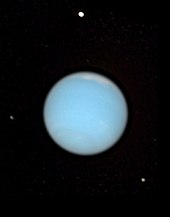
Neptune is the eighth and farthest known planet from the Sun in the Solar System. In the Solar System, it is the fourth-largest planet by diameter, the third-most-massive planet, and the densest giant planet. Neptune is 17 times the mass of Earth and is slightly more massive than its near-twin Uranus, which is 15 times the mass of Earth and slightly larger than Neptune. Neptune orbits the Sun once every 164.8 years at an average distance of 30.1 astronomical units (4.50×10⁹ km). It is named after the Roman god of the sea and has the astronomical symbol , a stylised version of the god Neptune's trident.
Neptune is not visible to the unaided eye and is the only planet in the Solar System found by mathematical prediction rather than by empirical observation. Unexpected changes in the orbit of Uranus led Alexis Bouvard to deduce that its orbit was subject to gravitational perturbation by an unknown planet. Neptune was subsequently observed with a telescope on 23 September 1846 by Johann Galle within a degree of the position predicted by Urbain Le Verrier. Its largest moon, Triton, was discovered shortly thereafter, though none of the planet's remaining known 14 moons were located telescopically until the 20th century. The planet's distance from Earth gives it a very small apparent size, making it challenging to study with Earth-based telescopes. Neptune was visited by Voyager 2, when it flew by the planet on 25 August 1989. The advent of the Hubble Space Telescope and large ground-based telescopes with adaptive optics has recently allowed for additional detailed observations from afar.
Like Jupiter and Saturn, Neptune's atmosphere is composed primarily of hydrogen and helium, along with traces of hydrocarbons and possibly nitrogen, but it contains a higher proportion of "ices" such as water, ammonia, and methane. However, its interior, like that of Uranus, is primarily composed of ices and rock, which is why Uranus and Neptune are normally considered "ice giants" to emphasise this distinction. Traces of methane in the outermost regions in part account for the planet's blue appearance.
In contrast to the hazy, relatively featureless atmosphere of Uranus, Neptune's atmosphere has active and visible weather patterns. For example, at the time of the Voyager 2 flyby in 1989, the planet's southern hemisphere had a Great Dark Spot comparable to the Great Red Spot on Jupiter. These weather patterns are driven by the strongest sustained winds of any planet in the Solar System, with recorded wind speeds as high as 2,100 kilometres per hour (580 m/s; 1,300 mph). Because of its great distance from the Sun, Neptune's outer atmosphere
is one of the coldest places in the Solar System, with temperatures at its cloud tops approaching 55 K (−218 °C). Temperatures at the planet's centre are approximately 5,400 K (5,100 °C). Neptune has a faint and fragmented ring system (labelled "arcs"), which was discovered in 1982, then later confirmed by Voyager 2.

Discovery


Some of the earliest recorded observations ever made through a telescope, Galileo's drawings on 28 December 1612 and 27 January 1613, contain plotted points that match up with what is now known to be the position of Neptune. On both occasions, Galileo seems to have mistaken Neptune for a fixed star when it appeared close—in conjunction—to Jupiter in the night sky; hence, he is not credited with Neptune's discovery. At his first observation in December 1612, Neptune was almost stationary in the sky because it had just turned retrograde that day. This apparent backward motion is created when Earth's orbit takes it past an outer planet. Because Neptune was only beginning its yearly retrograde cycle, the motion of the planet was far too slight to be detected with Galileo's small telescope. In July 2009, University of Melbourne physicist David Jamieson announced new evidence suggesting that Galileo was at least aware that the "star" he had observed had moved relative to the fixed stars.
In 1821, Alexis Bouvard published astronomical tables of the orbit of Neptune's neighbour Uranus. Subsequent observations revealed substantial deviations from the tables, leading Bouvard to hypothesise that an unknown body was perturbing the orbit through gravitational interaction. In 1843, John Couch Adams began work on the orbit of Uranus using the data he had. Via Cambridge Observatory director James Challis, he requested extra data from Sir George Airy, the Astronomer Royal, who supplied it in February 1844. Adams continued to work in 1845–46 and produced several different estimates of a new planet.
In 1845–46, Urbain Le Verrier, independently of Adams, developed his own calculations but aroused no enthusiasm in his compatriots. In June 1846, upon seeing Le Verrier's first published estimate of the planet's longitude and its similarity to Adams's estimate, Airy persuaded Challis to search for the planet. Challis vainly scoured the sky throughout August and September.
Meanwhile, Le Verrier by letter urged Berlin Observatory astronomer Johann Gottfried Galle to search with the observatory's refractor. Heinrich d'Arrest, a student at the observatory, suggested to Galle that they could compare a recently drawn chart of the sky in the region of Le Verrier's predicted location with the current sky to seek the displacement characteristic of a planet, as opposed to a fixed star. On the evening of 23 September 1846, the day Galle received the letter, he discovered Neptune within 1° of where Le Verrier had predicted it to be, about 12° from Adams' prediction. Challis later realised that he had observed the planet twice, on 4 and 12 August, but did not recognise it as a planet because he lacked an up-to-date star map and was distracted by his concurrent work on comet observations.
In the wake of the discovery, there was much nationalistic rivalry between the French and the British over who deserved credit for the discovery. Eventually, an international consensus emerged that both Le Verrier and Adams jointly deserved credit. Since 1966, Dennis Rawlins has questioned the credibility of Adams's claim to co-discovery, and the issue was re-evaluated by historians with the return in 1998 of the "Neptune papers" (historical documents) to the Royal Observatory, Greenwich. After reviewing the documents, they suggest that "Adams does not deserve equal credit with Le Verrier for the discovery of Neptune. That credit belongs only to the person who succeeded both in predicting the planet's place and in convincing astronomers to search for it.

Internal structure

Neptune's internal structure resembles that of Uranus. Its atmosphere forms about 5% to 10% of its mass and extends perhaps 10% to 20% of the way towards the core, where it reaches pressures of about 10 GPa, or about 100,000 times that of Earth's atmosphere. Increasing concentrations of methane, ammonia and water are found in the lower regions of the atmosphere.
 
The internal structure of Neptune:
1.            Upper atmosphere, top clouds
2.            Atmosphere consisting of hydrogen, helium and methane gas
3.            Mantle consisting of water, ammonia and methane ices
4.            Core consisting of rock (silicates and nickel–iron)
The mantle is equivalent to 10 to 15 Earth masses and is rich in water, ammonia and methane. As is customary in planetary science, this mixture is referred to as icy even though it is a hot, dense fluid. This fluid, which has a high electrical conductivity, is sometimes called a water–ammonia ocean. The mantle may consist of a layer of ionic water in which the water molecules break down into a soup of hydrogen and oxygen ions, and deeper down superionic water in which the oxygen crystallises but the hydrogen ions float around freely within the oxygen lattice. At a depth of 7,000 km, the conditions may be such that methane decomposes into diamond crystals that rain downwards like hailstones. Very-high-pressure experiments at the Lawrence Livermore National Laboratory suggest that the base of the mantle may be an ocean of liquid carbon with floating solid 'diamonds'.
The core of Neptune is likely composed of iron, nickel and silicates, with an interior model giving a mass about 1.2 times that of Earth. The pressure at the centre is 7 Mbar (700 GPa), about twice as high as that at the centre of Earth, and the temperature may be 5,400 K.

Atmosphere


At high altitudes, Neptune's atmosphere is 80% hydrogen and 19% helium. A trace amount of methane is also present. Prominent absorption bands of methane exist at wavelengths above 600 nm, in the red and infrared portion of the spectrum. As with Uranus, this absorption of red light by the atmospheric methane is part of what gives Neptune its blue hue, although Neptune's vivid azure differs from Uranus's milder cyan. Because Neptune's atmospheric methane content is similar to that of Uranus, some unknown atmospheric constituent is thought to contribute to Neptune's colour.
Neptune's atmosphere is subdivided into two main regions: the lower troposphere, where temperature decreases with altitude, and the stratosphere, where temperature increases with altitude. The boundary between the two, the tropopause, lies at a pressure of 0.1 bars (10 kPa). The stratosphere then gives way to the thermosphere at a pressure lower than 10−5 to 10−4 bars (1 to 10 Pa). The thermosphere gradually transitions to the exosphere.

Models suggest that Neptune's troposphere is banded by clouds of varying compositions depending on altitude. The upper-level clouds lie at pressures below one bar, where the temperature is suitable for methane to condense. For pressures between one and five bars (100 and 500 kPa), clouds of ammonia and hydrogen sulfide are thought to form. Above a pressure of five bars, the clouds may consist of ammonia, ammonium sulfide, hydrogen sulfide and water. Deeper clouds of water ice should be found at pressures of about 50 bars (5.0 MPa), where the temperature reaches 273 K (0 °C). Underneath, clouds of ammonia and hydrogen sulfide may be found.
High-altitude clouds on Neptune have been observed casting shadows on the opaque cloud deck below. There are also high-altitude cloud bands that wrap around the planet at constant latitude. These circumferential bands have widths of 50–150 km and lie about 50–110 km above the cloud deck. These altitudes are in the layer where weather occurs, the troposphere. Weather does not occur in the higher stratosphere or thermosphere. Unlike Uranus, Neptune's composition has a higher volume of ocean, whereas Uranus has a smaller mantle.
Neptune's spectra suggest that its lower stratosphere is hazy due to condensation of products of ultraviolet photolysis of methane, such as ethane and ethyne. The stratosphere is also home to trace amounts of carbon monoxide and hydrogen cyanide. The stratosphere of Neptune is warmer than that of Uranus due to the elevated concentration of hydrocarbons.
For reasons that remain obscure, the planet's thermosphere is at an anomalously high temperature of about 750 K. The planet is too far from the Sun for this heat to be generated by ultraviolet radiation. One candidate for a heating mechanism is atmospheric interaction with ions in the planet's magnetic field. Other candidates are gravity waves from the interior that dissipate in the atmosphere. The thermosphere contains traces of carbon dioxide and water, which may have been deposited from external sources such as meteorites and dust.

Moons


Neptune has 14 known moons. Triton is the largest Neptunian moon, comprising more than 99.5% of the mass in orbit around Neptune, and it is the only one massive enough to be spheroidal. Triton was discovered by William Lassell just 17 days after the discovery of Neptune itself. Unlike all other large planetary moons in the Solar System, Triton has a retrograde orbit, indicating that it was captured rather than forming in place; it was probably once a dwarf planet in the Kuiper belt. It is close enough to Neptune to be locked into a synchronous rotation, and it is slowly spiralling inward because of tidal acceleration. It will eventually be torn apart, in about 3.6 billion years, when it reaches the Roche limit. In 1989, Triton was the coldest object that had yet been measured in the Solar System, with estimated temperatures of 38 K (−235 °C).
Neptune's second known satellite (by order of discovery), the irregular moon Nereid, has one of the most eccentric orbits of any satellite in the Solar System. The eccentricity of 0.7512 gives it an apoapsis that is seven times its periapsis distance from Neptune.

From July to September 1989, Voyager 2 discovered six moons of Neptune. Of these, the irregularly shaped Proteus is notable for being as large as a body of its density can be without being pulled into a spherical shape by its own gravity. Although the second-most-massive Neptunian moon, it is only 0.25% the mass of Triton. Neptune's innermost four moons—Naiad, Thalassa, Despina and Galatea—orbit close enough to be within Neptune's rings. The next-farthest out, Larissa, was originally discovered in 1981 when it had occulted a star. This occultation had been attributed to ring arcs, but when Voyager 2 observed Neptune in 1989, Larissa was found to have caused it. Five new irregular moons discovered between 2002 and 2003 were announced in 2004. A new moon and the smallest yet, S/2004 N 1, was found in 2013. Because Neptune was the Roman god of the sea, Neptune's moons have been named after lesser sea gods.

Planetary rings


Neptune has a planetary ring system, though one much less substantial than that of Saturn. The rings may consist of ice particles coated with silicates or carbon-based material, which most likely gives them a reddish hue. The three main rings are the narrow Adams Ring, 63,000 km from the centre of Neptune, the Le Verrier Ring, at 53,000 km, and the broader, fainter Galle Ring, at 42,000 km. A faint outward extension to the Le Verrier Ring has been named Lassell; it is bounded at its outer edge by the Arago Ring at 57,000 km.
Image result for neptune ringsThe first of these planetary rings was detected in 1968 by a team led by Edward Guinan. In the early 1980s, analysis of this data along with newer observations led to the hypothesis that this ring might be incomplete. Evidence that the rings might have gaps first arose during a stellar occultation in 1984 when the rings obscured a star on immersion but not on emersion. Images from Voyager 2 in 1989 settled the issue by showing several faint rings.
The outermost ring, Adams, contains five prominent arcs now named Courage, Liberté, Egalité 1, Egalité 2 and Fraternité (Courage, Liberty, Equality and Fraternity). The existence of arcs was difficult to explain because the laws of motion would predict that arcs would spread out into a uniform ring over short timescales. Astronomers now estimate that the arcs are corralled into their current form by the gravitational effects of Galatea, a moon just inward from the ring.
Earth-based observations announced in 2005 appeared to show that Neptune's rings are much more unstable than previously thought. Images taken from the W. M. Keck Observatory in 2002 and 2003 show considerable decay in the rings when compared to images by Voyager 2. In particular, it seems that the Liberté arc might disappear in as little as one century.

Observation

With an apparent magnitude between +7.7 and +8.0, Neptune is never visible to the naked eye and can be outshone by Jupiter's Galilean moons, the dwarf planet Ceres and the asteroids 4 Vesta, 2 Pallas, 7 Iris, 3 Juno, and 6 Hebe. A telescope or strong binoculars will resolve Neptune as a small blue disk, similar in appearance to Uranus.
Because of the distance of Neptune from Earth, its angular diameter only ranges from 2.2 to 2.4 arcseconds, the smallest of the Solar System planets. Its small apparent size makes it challenging to study it visually. Most telescopic data was fairly limited until the advent of the Hubble Space Telescope and large ground-based telescopes with adaptive optics (AO). The first scientifically useful observation of Neptune from ground-based telescopes using adaptive optics, was commenced in 1997 from Hawaii. Neptune is currently entering its spring and summer season and has been shown to be heating up, with increased atmospheric activity and brightness as a consequence. Combined with technological advancements, ground-based telescopes with adaptive optics are recording increasingly more detailed images of it. Both Hubble and the adaptive-optics telescopes on Earth have made many new discoveries within the Solar System since the mid-1990s, with a large increase in the number of known satellites and moons around the outer planet, among others. In 2004 and 2005, five new small satellites of Neptune with diameters between 38 and 61 kilometres were discovered.
From Earth, Neptune goes through apparent retrograde motion every 367 days, resulting in a looping motion against the background stars during each opposition. These loops carried it close to the 1846 discovery coordinates in April and July 2010 and again in October and November 2011.
Observation of Neptune in the radio-frequency band shows that it is a source of both continuous emission and irregular bursts. Both sources are thought to originate from its rotating magnetic field. In the infrared part of the spectrum, Neptune's storms appear bright against the cooler background, allowing the size and shape of these features to be readily tracked.

Exploration

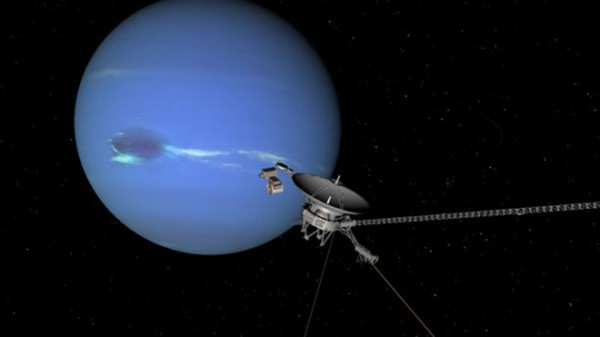
Voyager 2 is the only spacecraft that has visited Neptune. The spacecraft's closest approach to the planet occurred on 25 August 1989. Because this was the last major planet the spacecraft could visit, it was decided to make a close flyby of the moon Triton, regardless of the consequences to the trajectory, similarly to what was done for Voyager 1's encounter with Saturn and its moon Titan. The images relayed back to Earth from Voyager 2 became the basis of a 1989 PBS all-night program, Neptune All Night.
Image result for neptune explorationDuring the encounter, signals from the spacecraft required 246 minutes to reach Earth. Hence, for the most part, Voyager 2's mission relied on preloaded commands for the Neptune encounter. The spacecraft performed a near-encounter with the moon Nereid before it came within 4,400 km of Neptune's atmosphere on 25 August, then passed close to the planet's largest moon Triton later the same day.
The spacecraft verified the existence of a magnetic field surrounding the planet and discovered that the field was offset from the centre and tilted in a manner similar to the field around Uranus. Neptune's rotation period was determined using measurements of radio emissions and Voyager 2 also showed that Neptune had a surprisingly active weather system. Six new moons were discovered, and the planet was shown to have more than one ring.
The flyby also provided the first accurate measurement of Neptune's mass which was found to be 0.5 percent less than previously calculated. The new figure disproved the hypothesis that an undiscovered Planet X acted upon the orbits of Neptune and Uranus.
After the Voyager 2 flyby mission, the next step in scientific exploration of the Neptunian system, is considered to be a Flagship orbital mission. Such a hypothetical mission is envisioned to be possible in the late 2020s or early 2030s. However, there have been a couple of discussions to launch Neptune missions sooner. In 2003, there was a proposal in NASA's "Vision Missions Studies" for a "Neptune Orbiter with Probes" mission that does Cassini-level science. Another, more recent proposal was for Argo, a flyby spacecraft to be launched in 2019, that would visit Jupiter, Saturn, Neptune, and a Kuiper belt object. The focus would be on Neptune and its largest moon Triton to be investigated around 2029. The proposed New Horizons 2 mission (which was later scrapped) might also have done a close flyby of the Neptunian system.