The Saturn
(Saturn: Much ring holder,Internal structure, atmosphere, Moons,Planetary Rings,missions)

Saturn is the sixth planet from the Sun and the second-largest in the Solar System, after Jupiter. It is a gas giant with an average radius about nine times that of Earth. Although it has only one-eighth the average density of Earth, with its larger volume Saturn is just over 95 times more massive. Saturn is named after the Roman god of agriculture; its astronomical symbol (♄) represents the god's sickle.
Saturn's interior is probably composed of a core of iron–nickel and rock (silicon and oxygen compounds). This core is surrounded by a deep layer of metallic hydrogen, an intermediate layer of liquid hydrogen and liquid helium, and finally outside the Frenkel line a gaseous outer layer. Saturn has a pale yellow hue due to ammonia crystals in its upper atmosphere. Electrical current within the metallic hydrogen layer is thought to give rise to Saturn's planetary magnetic field, which is weaker than Earth's, but has a magnetic moment 580 times that of Earth due to Saturn's larger size. Saturn's magnetic field strength is around one-twentieth of Jupiter's. The outer atmosphere is generally bland and lacking in contrast, although long-lived features can appear. Wind speeds on Saturn can reach 1,800 km/h (500 m/s), higher than on Jupiter, but not as high as those on Neptune.
Saturn has a prominent ring system that consists of nine continuous main rings and three discontinuous arcs and that is composed mostly of ice particles with a smaller amount of rocky debris and dust. 62 moons are known to orbit Saturn, of which fifty-three are officially named. This does not include the hundreds of moonlets comprising the rings. Titan, Saturn's largest moon, and the second-largest in the Solar System, is larger than the planet Mercury, although less massive, and is the only moon in the Solar System to have a substantial atmosphere
Internal structure
Despite consisting mostly of hydrogen and helium, most of Saturn's mass is not in the gas phase, because hydrogen becomes a non-ideal liquid when the density is above 0.01 g/cm3, which is reached at a radius containing 99.9% of Saturn's mass. The temperature, pressure, and density inside Saturn all rise steadily toward the core, which causes hydrogen to transition into a metal in the deeper layers.
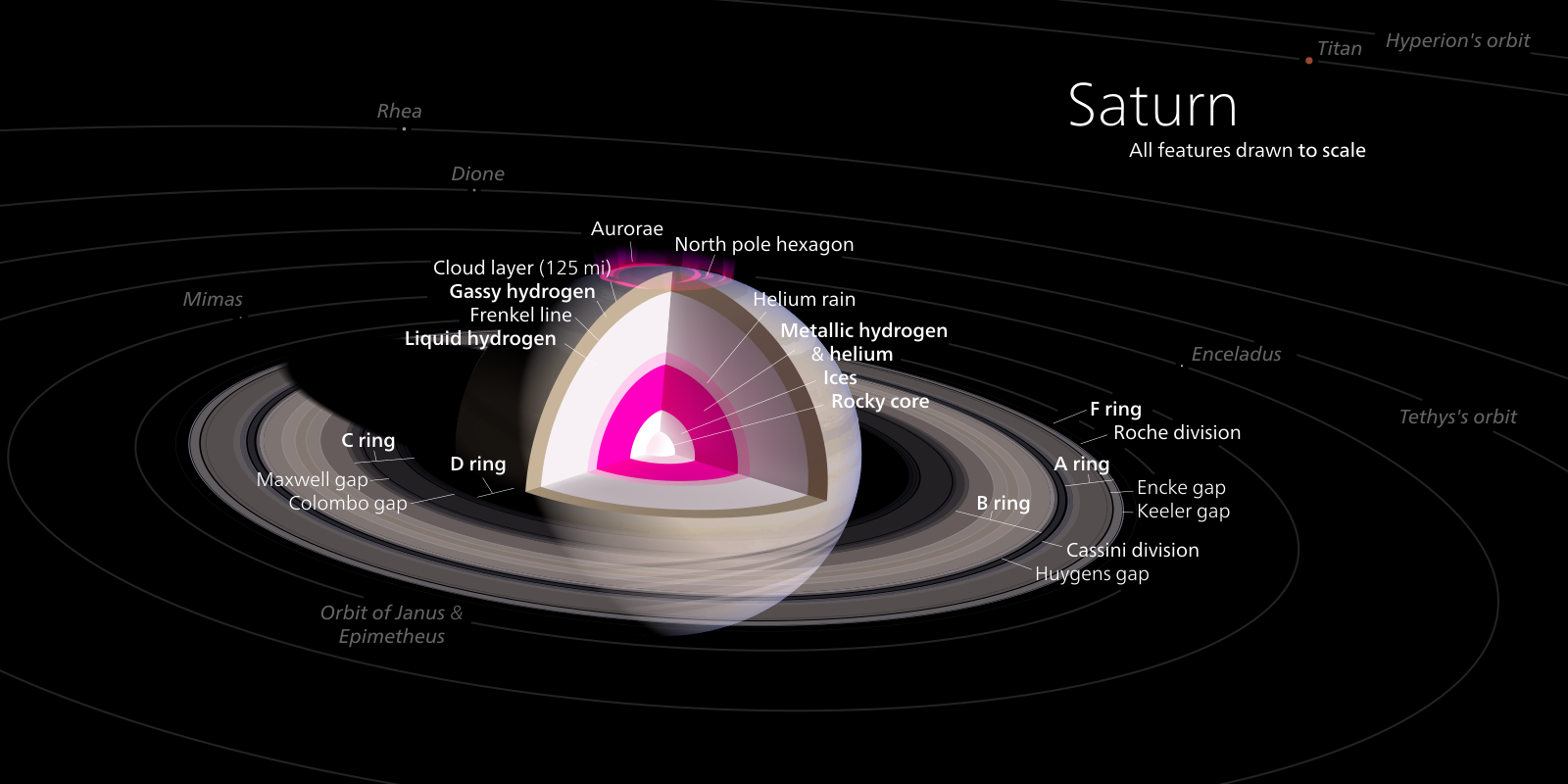
Standard planetary models suggest that the interior of Saturn is similar to that of Jupiter, having a small rocky core surrounded by hydrogen and helium with trace amounts of various volatiles. This core is similar in composition to the Earth, but more dense. Examination of Saturn's gravitational moment, in combination with physical models of the interior, allowed French astronomers Didier Saumon and Tristan Guillot to place constraints on the mass of Saturn's core. In 2004, they estimated that the core must be 9–22 times the mass of the Earth, which corresponds to a diameter of about 25,000 km. This is surrounded by a thicker liquid metallic hydrogen layer, followed by a liquid layer of helium-saturated molecular hydrogen that gradually transitions to a gas with increasing altitude. The outermost layer spans 1,000 km and consists of gas.
Saturn has a hot interior, reaching 11,700 °C at its core, and it radiates 2.5 times more energy into space than it receives from the Sun. Jupiter's thermal energy is generated by the Kelvin–Helmholtz mechanism of slow gravitational compression, but this alone may not be sufficient to explain heat production for Saturn, because it is less massive. An alternative or additional mechanism may be generation of heat through the "raining out" of droplets of helium deep in Saturn's interior. As the droplets descend through the lower-density hydrogen, the process releases heat by friction and leaves Saturn's outer layers depleted of helium. These descending droplets may have accumulated into a helium shell surrounding the core.
Atmosphere
The outer atmosphere of Saturn contains 96.3% molecular hydrogen and 3.25% helium by volume. The proportion of helium is significantly deficient compared to the abundance of this element in the Sun. The quantity of elements heavier than helium (metallicity) is not known precisely, but the proportions are assumed to match the primordial abundances from the formation of the Solar System. The total mass of these heavier elements is estimated to be 19–31 times the mass of the Earth, with a significant fraction located in Saturn's core region.
Trace amounts of ammonia, acetylene, ethane, propane, phosphine and methane have been detected in Saturn's atmosphere. The upper clouds are composed of ammonia crystals, while the lower level clouds appear to consist of either ammonium hydrosulfide (NH4SH) or water. Ultraviolet radiation from the Sun causes methane photolysis in the upper atmosphere, leading to a series of hydrocarbon chemical reactions with the resulting products being carried downward by eddies and diffusion. This photochemical cycle is modulated by Saturn's annual seasonal cycle.
Cloud layers
A global storm girdles the planet in 2011. The head of the storm (bright area) passes the tail circling around the left limb.
Saturn's atmosphere exhibits a banded pattern similar to Jupiter's, but Saturn's bands are much fainter and are much wider near the equator. The nomenclature used to describe these bands is the same as on Jupiter. Saturn's finer cloud patterns were not observed until the flybys of the Voyager spacecraft during the 1980s. Since then, Earth-based telescopy has improved to the point where regular observations can be made.
The composition of the clouds varies with depth and increasing pressure. In the upper cloud layers, with the temperature in the range 100–160 K and pressures extending between 0.5–2 bar, the clouds consist of ammonia ice. Water ice clouds begin at a level where the pressure is about 2.5 bar and extend down to 9.5 bar, where temperatures range from 185–270 K. Intermixed in this layer is a band of ammonium hydrosulfide ice, lying in the pressure range 3–6 bar with temperatures of 290–235 K. Finally, the lower layers, where pressures are between 10–20 bar and temperatures are 270–330 K, contains a region of water droplets with ammonia in aqueous solution.
Saturn's usually bland atmosphere occasionally exhibits long-lived ovals and other features common on Jupiter. In 1990, the Hubble Space Telescope imaged an enormous white cloud near Saturn's equator that was not present during the Voyager encounters, and in 1994 another smaller storm was observed. The 1990 storm was an example of a Great White Spot, a unique but short-lived phenomenon that occurs once every Saturnian year, roughly every 30 Earth years, around the time of the northern hemisphere's summer solstice. Previous Great White Spots were observed in 1876, 1903, 1933 and 1960, with the 1933 storm being the most famous. If the periodicity is maintained, another storm will occur in about 2020.
The winds on Saturn are the second fastest among the Solar System's planets, after Neptune's. Voyager data indicate peak easterly winds of 500 m/s (1800 km/h). In images from the Cassini spacecraft during 2007, Saturn's northern hemisphere displayed a bright blue hue, similar to Uranus. The color was most likely caused by Rayleigh scattering. Thermography has shown that Saturn's south pole has a warm polar vortex, the only known example of such a phenomenon in the Solar System. Whereas temperatures on Saturn are normally −185 °C, temperatures on the vortex often reach as high as −122 °C, suspected to be the warmest spot on Saturn.
North pole hexagonal cloud pattern
 A persisting hexagonal wave pattern around the north polar vortex in the atmosphere at about 78°N was first noted in the Voyager images. The sides of the hexagon are each about 13,800 km (8,600 mi) long, which is longer than the diameter of the Earth. The entire structure rotates with a period of 10h 39m 24s (the same period as that of the planet's radio emissions) which is assumed to be equal to the period of rotation of Saturn's interior. The hexagonal feature does not shift in longitude like the other clouds in the visible atmosphere. The pattern's origin is a matter of much speculation. Most scientists think it is a standing wave pattern in the atmosphere. Polygonal shapes have been replicated in the laboratory through differential rotation of fluids.
South pole vortex

HST imaging of the south polar region indicates the presence of a jet stream, but no strong polar vortex nor any hexagonal standing wave. NASA reported in November 2006 that Cassini had observed a "hurricane-like" storm locked to the south pole that had a clearly defined eyewall. Eyewall clouds had not previously been seen on any planet other than Earth. For example, images from the Galileo spacecraft did not show an eyewall in the Great Red Spot of Jupiter.
The south pole storm may have been present for billions of years. This vortex is comparable to the size of Earth, and it has winds of 550 km/h.
Planetary rings
 Saturn is probably best known for the system of planetary rings that makes it visually unique. The rings extend from 6,630 km to 120,700 km outward from Saturn's equator, average approximately 20 meters in thickness and are composed of 93% water ice with traces of tholin impurities and 7% amorphous carbon. The particles that make up the rings range in size from specks of dust up to 10 m. While the other gas giants also have ring systems, Saturn's is the largest and most visible.
There are two main hypotheses regarding the origin of the rings. One hypothesis is that the rings are remnants of a destroyed moon of Saturn. The second hypothesis is that the rings are left over from the original nebular material from which Saturn formed. Some ice in the E ring comes from the moon Enceladus's geysers.
In the past, astronomers once thought the rings formed alongside the planet when it formed billions of years ago. Instead, the age of these planetary rings is probably some hundreds of millions of years.
Beyond the main rings at a distance of 12 million km from the planet is the sparse Phoebe ring, which is tilted at an angle of 27° to the other rings and, like Phoebe, orbits in retrograde fashion.
Some of the moons of Saturn, including Pandora and Prometheus, act as shepherd moons to confine the rings and prevent them from spreading out. Pan and Atlas cause weak, linear density waves in Saturn's rings that have yielded more reliable calculations of their masses.
History of observation and exploration
There have been three main phases in the observation and exploration of Saturn. The first era was ancient observations (such as with the naked eye), before the invention of the modern telescopes. Starting in the 17th century progressively more advanced telescopic observations from Earth have been made. The other type is visitation by spacecraft, either by orbiting or flyby. In the 21st century observations continue from the Earth (or Earth-orbiting observatories) and from the Cassini orbiter at Saturn.
Modern NASA and ESA probes
Pioneer 11 flyby
Pioneer 11 carried out the first flyby of Saturn in September 1979, when it passed within 20,000 km of the planet's cloud tops. Images were taken of the planet and a few of its moons, although their resolution was too low to discern surface detail. The spacecraft also studied Saturn's rings, revealing the thin F-ring and the fact that dark gaps in the rings are bright when viewed at high phase angle (towards the Sun), meaning that they contain fine light-scattering material. In addition, Pioneer 11 measured the temperature of Titan.
Voyager flybys
In November 1980, the Voyager 1 probe visited the Saturn system. It sent back the first high-resolution images of the planet, its rings and satellites. Surface features of various moons were seen for the first time. Voyager 1 performed a close flyby of Titan, increasing knowledge of the atmosphere of the moon. It proved that Titan's atmosphere is impenetrable in visible wavelengths; therefore no surface details were seen. The flyby changed the spacecraft's trajectory out from the plane of the Solar System.
Almost a year later, in August 1981, Voyager 2 continued the study of the Saturn system. More close-up images of Saturn's moons were acquired, as well as evidence of changes in the atmosphere and the rings. Unfortunately, during the flyby, the probe's turnable camera platform stuck for a couple of days and some planned imaging was lost. Saturn's gravity was used to direct the spacecraft's trajectory towards Uranus.
The probes discovered and confirmed several new satellites orbiting near or within the planet's rings, as well as the small Maxwell Gap (a gap within the C Ring) and Keeler gap (a 42 km wide gap in the A Ring).
Cassini–Huygens spacecraft
On 1 July 2004, the Cassini–Huygens space probe performed the SOI (Saturn Orbit Insertion) maneuver and entered orbit around Saturn. Before the SOI, Cassini had already studied the system extensively. In June 2004, it had conducted a close flyby of Phoebe, sending back high-resolution images and data.

Cassini's flyby of Saturn's largest moon, Titan, has captured radar images of large lakes and their coastlines with numerous islands and mountains. The orbiter completed two Titan flybys before releasing the Huygens probe on 25 December 2004. Huygens descended onto the surface of Titan on 14 January 2005, sending a flood of data during the atmospheric descent and after the landing. Cassini has since conducted multiple flybys of Titan and other icy satellites.
Since early 2005, scientists have been tracking lightning on Saturn. The power of the lightning is approximately 1,000 times that of lightning on Earth.
At Enceladus's south pole geysers spray water from many locations along the tiger stripes.
In 2006, NASA reported that Cassini had found evidence of liquid water reservoirs that erupt in geysers on Saturn's moon Enceladus. Images had shown jets of icy particles being emitted into orbit around Saturn from vents in the moon's south polar region. According to Andrew Ingersoll, California Institute of Technology, "Other moons in the Solar System have liquid-water oceans covered by kilometers of icy crust. What's different here is that pockets of liquid water may be no more than tens of meters below the surface." Over 100 geysers have been identified on Enceladus. In May 2011, NASA scientists at an Enceladus Focus Group Conference reported that Enceladus "is emerging as the most habitable spot beyond Earth in the Solar System for life as we know it".
Cassini photographs have led to other significant discoveries. They have revealed a previously undiscovered planetary ring, outside the brighter main rings of Saturn and inside the G and E rings. The source of this ring is hypothesized to be the crashing of a meteoroid off Janus and Epimetheus. In July 2006, Cassini images provided evidence of hydrocarbon lakes near Titan's north pole, the presence of which were confirmed in January 2007. In March 2007, additional images near Titan's north pole revealed hydrocarbon seas, the largest of which is almost the size of the Caspian Sea. In October 2006, the probe detected an 8,000 km diameter cyclone-like storm with an eyewall at Saturn's south pole.
From 2004 to 2 November 2009, the probe discovered and confirmed eight new satellites. Its primary mission ended in 2008 when the spacecraft had completed 74 orbits around the planet. The probe's mission was extended to September 2010 and then extended again to 2017, to study a full period of Saturn's seasons.
In April 2013 Cassini sent back images of a hurricane at the planet's north pole 20 times larger than those found on Earth, with winds faster than 530 km/h.
On 19 July 2013, "The Day the Earth Smiled", Cassini was pointed towards Earth to capture an image of the Earth and the Moon (and, as well, Venus and Mars) as part of a natural light, multi-image portrait of the entire Saturn system. It was the first time NASA informed the people of Earth that a long-distance photo was being taken in advance.
Possible future missions
The continued exploration of Saturn is still considered to be a viable option for NASA as part of their ongoing New Frontiers program of missions. NASA previously requested for plans to be put forward for a mission to Saturn that included an atmospheric entry probe and possible investigations into the habitability and possible discovery of life on Saturn's moons Titan and Enceladus.